
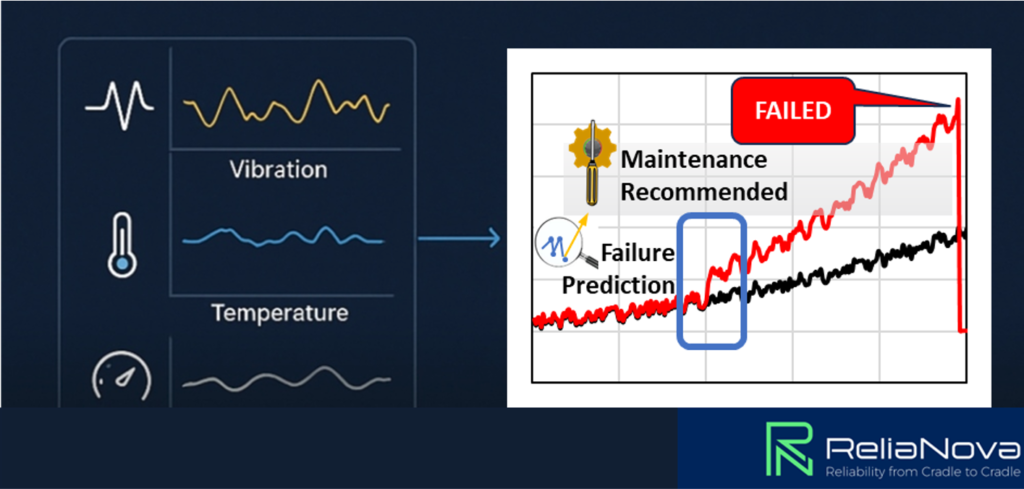
In modern engineering, data has become the backbone of reliability. Where reliability engineering once relied heavily on testing and historical failure rates, today’s connected world is reshaping the discipline.
Every sensor, log file, and control system now produces a continuous stream of health and usage data — vibration levels in rotating equipment, temperature cycling in electronics, shock events during transport, fluid quality in pumps, or real-time performance from fielded assets. This is no longer just information; it’s early warning.
When used effectively, this data lets engineers predict failures before they disrupt operations and plan maintenance based on actual condition rather than static intervals. The result: safer systems, better uptime, lower life-cycle cost, and stronger customer trust.
At ReliaNova, we help organizations harness this potential by combining data science with engineering fundamentals:
- Sensor-driven reliability insights — turning raw IoT data into meaningful performance and stress indicators.
- Predictive analytics & PHM (Prognostics and Health Management) — fusing machine learning with physics-of-failure (PoF) models to forecast when components will degrade or fail.
- Failure data integration — pulling warranty returns, accelerated test results, and field performance metrics together to track annualized failure rates (AFR) and drive design improvements.
- Actionable dashboards — enabling engineering, maintenance, and operations teams to visualize system health, prioritize interventions, and allocate resources effectively.
But data alone doesn’t create reliability. It’s the integration of insights back into design and manufacturing — a loop that closes the gap between how a product is built and how it performs in the real world. The more we connect failure signatures to Design for Reliability (DfR) decisions and Critical-to-Reliability (CTR) features, the faster we can eliminate weaknesses before scale-up.
Data-driven reliability is transforming organizations from reactive to proactive. Instead of waiting for breakdowns and scrambling to fix them, teams can see risk building and act early — avoiding safety incidents, downtime, and unexpected cost.
Real-Life Example: A wind turbine gearbox equipped with vibration and oil-debris sensors flags abnormal wear long before it seizes. Instead of waiting for catastrophic failure and costly crane replacements, maintenance team scheduled service proactively, avoiding extended downtime and protecting the asset’s availability.
💡 Have you leveraged sensor data to move toward predictive maintenance? Let’s discuss how to make your data actionable.
🌐 https://relianova.com/contact-us/
📧 info@relianova.com