
The Bridge From Design and Manufacturing to Real-World Availability
Most engineers hear the word reliability and think of preventing failure — a discipline focused on fixing problems after they appear or reducing the likelihood of breakdowns.
That view captures only a small part of what reliability truly represents in modern engineering systems.
At ReliaNova, we define reliability much more broadly.
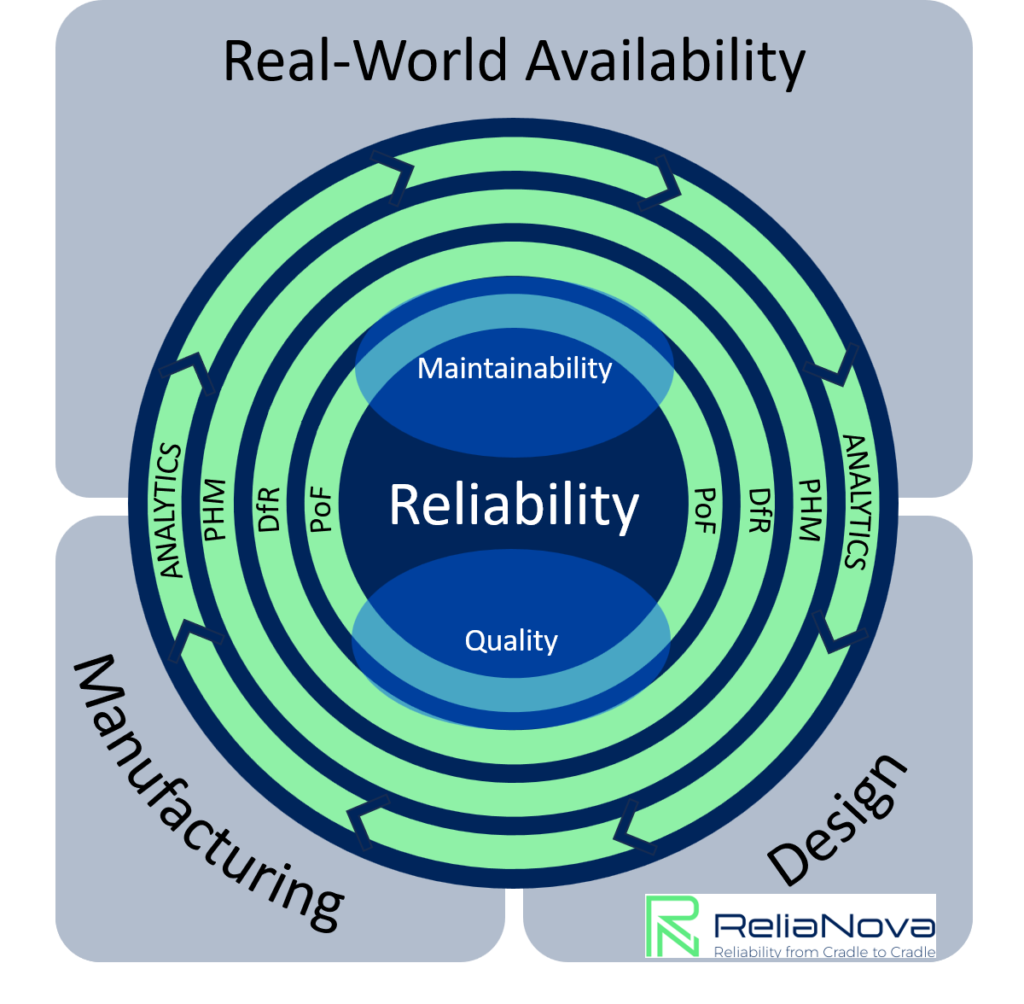
Reliability is the engineering discipline that connects design intent, manufacturing discipline, intelligent analytics, and real‑world performance into one continuous system. It bridges the gap between how a product was designed to behave and how it actually performs when exposed to real environments, real users, and real operational stresses.
When reliability is treated as a lifecycle discipline rather than a late validation step, organizations gain the ability to predict failure modes early, prevent costly redesigns, and build systems that sustain performance throughout their operational life.
In this sense, reliability is where engineering rigor meets customer trust — the point where a product’s promise becomes measurable, dependable performance in the real world.
Reliability Is Not a Phase — It Is a Lifecycle
Reliability does not begin in the test lab, and it does not end at product launch. It starts at concept, matures through production, lives in the field, and improves through structured feedback.
This is what we mean by Reliability From Cradle to Cradle™.
We integrate five tightly connected pillars:
- Design for Reliability (DfR): Failures are designed out early using Physics‑of‑Failure (PoF), FMMEA, stress‑strength analysis, and Critical‑to‑Reliability (CTR) definition. Reliability is engineered into the architecture — not inspected in later.
- Manufacturing & Time‑Zero Readiness: Reliability must survive scale. We align supplier capability, process controls, and qualification strategies to ensure day‑one production performance reflects design intent.
- PoF + AI‑Driven Prognostics: Understanding why systems degrade allows us to predict when they will. By combining physics‑based degradation modeling with AI‑enhanced analytics, we enable earlier detection, improved Remaining Useful Life (RUL) estimation, and fewer false alarms.
- Maintainability & Human Factors: Even robust systems require service. Designing for maintainability, modular replacement, and reduced MTTR ensures uptime remains predictable in real operating environments.
- Analytics & Closed‑Loop Learning: Field data, AFR trends, Weibull modeling, and structured RCA are converted into actionable design updates. Each product generation inherits the lessons of the last.
What This Means in Practice
Organizations that adopt a cradle‑to‑cradle reliability framework achieve:
- Reduced field failure rates and warranty exposure
- Elimination of system‑level single points of failure
- Faster qualification and fewer late design changes
- Stronger global supplier ecosystems
- Predictable uptime in complex hardware systems
Reliability becomes a strategic advantage — not a reactive repair function.
Reliability Without Borders
From design centers to global manufacturing lines to field operations, ReliaNova embeds reliability as a measurable, data‑driven discipline grounded in engineering science and enhanced by AI.
Reliability is not a final gate. It is a continuous commitment.
If your organization is ready to move from reactive troubleshooting to predictive performance, let’s start the conversation.